How do you do a triceps pushdown on the cable machine?
Rep range, rest and load step from the Month6 exercise catalog; last updated .
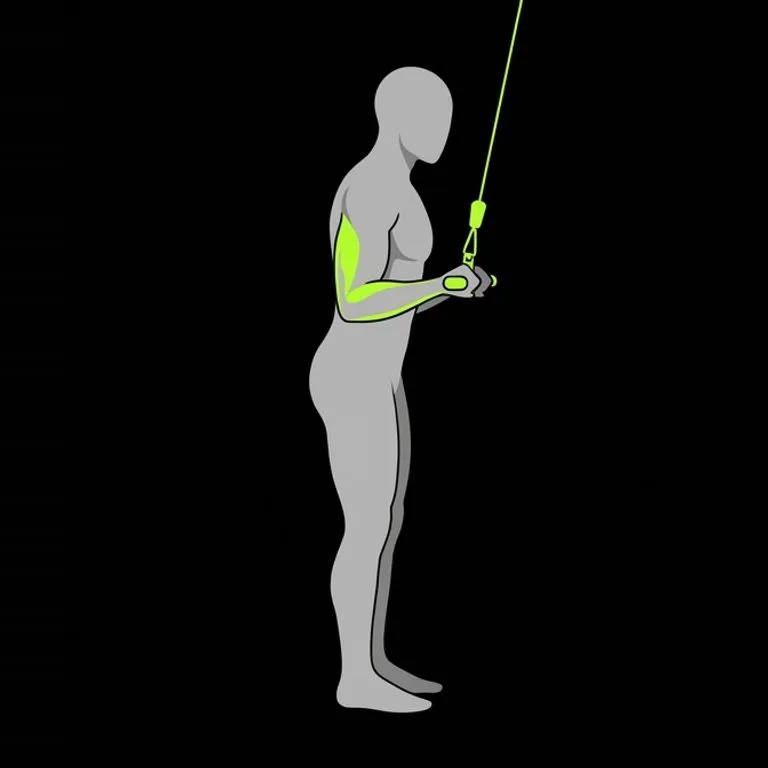
1 Set elbows and brace
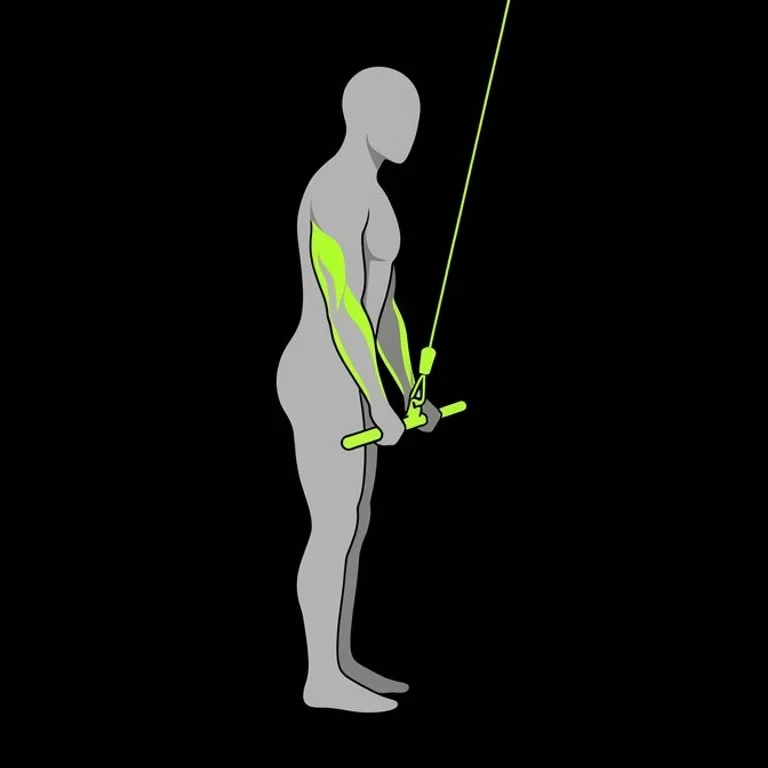
2 Move through the full range
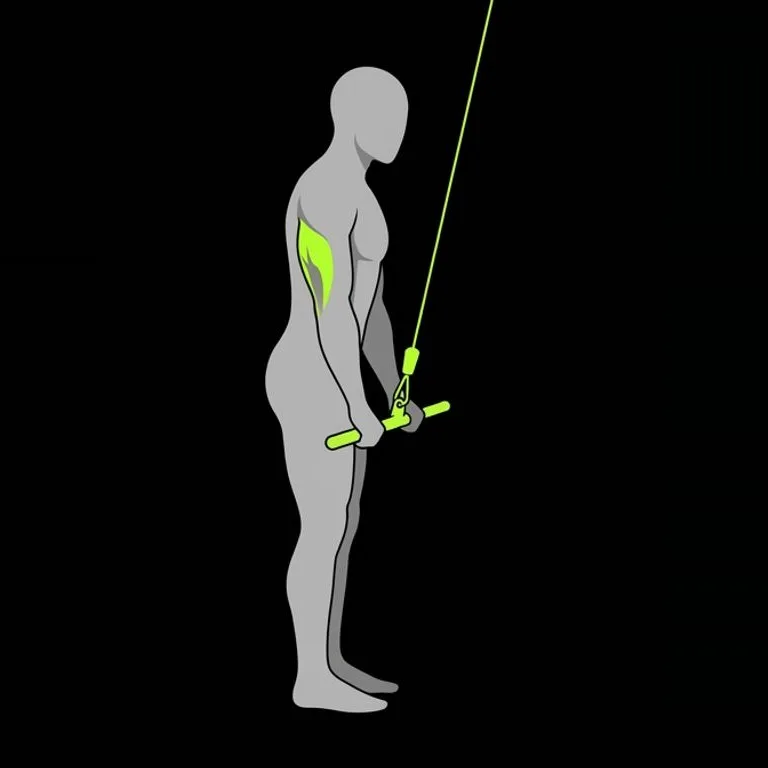
3 Squeeze, then lower slowly
Triceps pushdown at a glance
| Triceps pushdown | |
|---|---|
| Primary muscles | triceps (all three heads, mostly the outer and middle) |
| Also works | forearm muscles that hold the grip, midsection for keeping the torso still |
| Equipment | Gym (barbell, cable or machine) |
| Rep range | 10–15 reps |
| Rest between sets | 60 seconds |
| Load step | 1 kg (2.5 lb) |
The triceps pushdown is a cable exercise where you stand facing a high pulley and push a handle down by straightening your elbows. The triceps, on the back of the upper arm, is the muscle that straightens the elbow, so it does nearly all of the work. Because a cable stack holds the weight, you can change the load with a pin in seconds and the resistance stays steady through the whole rep.
It is one of the most common arm movements in any gym for good reason. The triceps makes up most of the upper arm's size, and it already works hard in presses and dips. The pushdown lets you add focused work after those heavier lifts without needing a spotter, a bench or a lot of setup. It is easy to learn, easy to load in small steps and easy to recover from, which makes it a good finisher for a push day.
How to set up
- Attach a straight bar, an angled bar or a rope to the high pulley. A bar lets you use a little more weight; a rope lets your hands spread apart at the bottom, which many people find kinder on the wrists and elbows.
- Grab the handle and step back just far enough that the cable hangs close to vertical in front of you. Standing too far away pulls your elbows forward and turns the lift into a pulling motion.
- Stand with your feet about hip width apart, or one foot slightly forward for balance. Hinge forward a little from the hips so your torso leans slightly over the handle.
- Pull the handle down until your elbows are bent and sit against your sides, slightly in front of your ribs. This is the starting position, and your upper arms should stay here for the whole set.
- Set your shoulders down and back. A proud chest keeps the shoulders out of the movement and leaves the triceps to work on its own.
How to do the triceps pushdown
- Push the handle down by straightening your elbows. Your forearms swing like the hands of a clock while your upper arms stay fixed beside your body.
- Lock out fully at the bottom and squeeze the back of your arms for a beat. With a rope, pull the ends slightly apart as you finish so your hands end up beside your thighs.
- Let the handle rise under control until your forearms are a little above parallel to the floor. Stop there; letting the hands come up to your face lets the elbows drift and lets the cable pull you out of position.
- Keep your wrists straight and in line with your forearms throughout. The push comes from the elbow, not from bending the wrist down at the end.
- Exhale as you push, inhale as the handle rises, and keep your torso angle the same from the first rep to the last.
Cues that help
- Pin your elbows to your sides. Fixed upper arms isolate the triceps. If the elbows move forward and back, the lats and chest join in and the triceps does less.
- Hands finish by your thighs. Aiming for a full lockout makes sure you reach the fully contracted position, which is where the triceps works hardest.
- Lean in, do not lean on it. A small forward lean lines you up over the cable, but pushing your body weight into the handle turns the rep into a bodyweight press.
- Spread the rope at the bottom. Pulling the rope ends apart lets your hands travel past your legs and adds a little extra range to each rep.
Common mistakes
- Elbows flaring out as the weight gets heavy. Lower the pin a step and keep the elbows tucked. Elbows that drift wide turn the pushdown into a press with the chest and shoulders.
- Using the whole body to drive the handle down. Stand taller and keep the torso still. If you have to crunch over the handle, the weight is more than your triceps can move alone.
- Letting the handle come up too high. Stop when your forearms are just above parallel. Going higher pulls the elbows forward off your sides.
- Cutting the lockout short. Straighten the arms fully on each rep. Partial reps at the top leave out the part of the movement that makes the triceps work hardest.
- Bending the wrists to finish. Keep a firm, straight wrist. Pressing with the palms and flexing the wrist moves the strain into the forearm.
Who it suits
The pushdown suits anyone with access to a cable machine who wants stronger, larger triceps. It is a good first arm exercise for a beginner because the path is simple and the weight changes easily, and it stays useful for experienced lifters as a finishing movement after pressing.
If your elbows feel wrong during pushdowns, stop, and try a different attachment or one of the swaps. An overhead extension works the long head of the triceps in a stretched position, and a close-grip push-up trains the triceps with no equipment at all.
How Month6 progresses it
Month6 starts the triceps pushdown at the bottom of its range, 10 reps, and adds reps session by session until every set reaches 15.
When every set of the triceps pushdown reaches the top of the range, the load goes up by the smallest sensible step for it — 1 kg (2.5 lb) — and the reps start again from 10.
Rest on the triceps pushdown is 60 seconds: an isolation or bodyweight movement recovers quickly.
Cable stacks move in fixed steps, and on some machines the first step up feels like a big jump. Use the reps inside the range to bridge it: stay at one pin until the top of the range is clean on every set, then move down a plate.
Progress on the pushdown should look strict. If you find yourself leaning harder or letting the elbows travel to keep the reps up, you have outgrown the weight's form before your arms have outgrown the weight. Hold that pin a little longer.
Swaps
- Overhead triceps extension Take the dumbbell overhead extension when there is no cable free or you want to train the long head of the triceps in a stretched position overhead. Hold one dumbbell in both hands behind your head and keep the elbows pointing up.
- Cable overhead extension Take the cable overhead extension when you want to stay on the cable but load the triceps from a stretched position. Face away from the pulley with a rope and extend your arms forward and up.
- Close-grip push-up Take the close-grip push-up when you have no cable or dumbbells at all. Keep your hands under your shoulders and your elbows close to your body so the triceps does most of the pressing.
Questions
Related exercises
More arms exercises: Arms · the whole library
Technique guidance for healthy adults, not medical advice; stop if a movement hurts. How every number is made, with its citations: Sources & method.
Log it, and let the plan move with you
Month6 logs every set of the triceps pushdown in one tap, offers the swap when the station is taken, and adds load when you reach the top of the range.