How do you do dips for chest with good form?
Rep range, rest and load step from the Month6 exercise catalog; last updated .
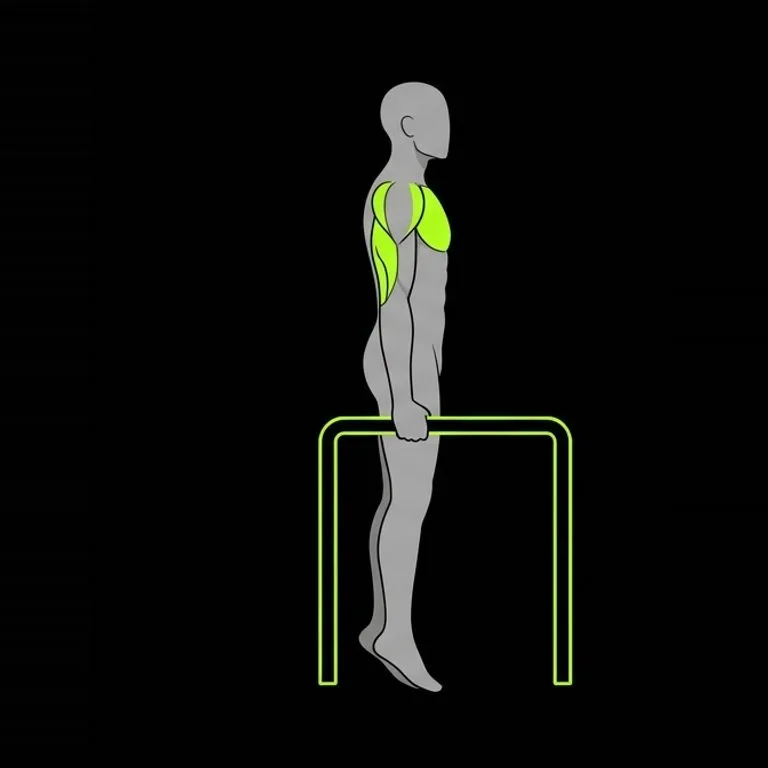
1 Set up braced, blades retracted
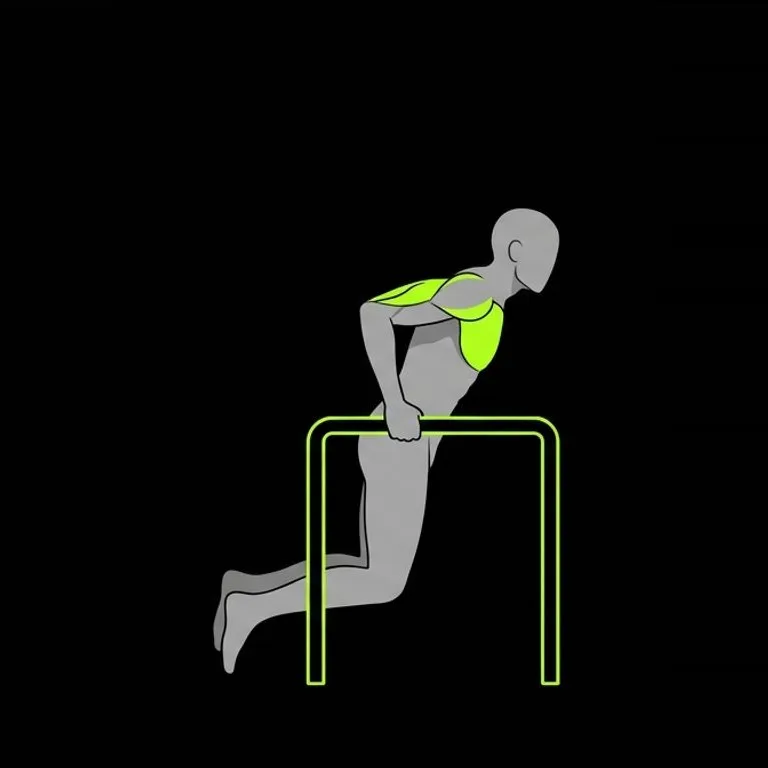
2 Lower to the target under control
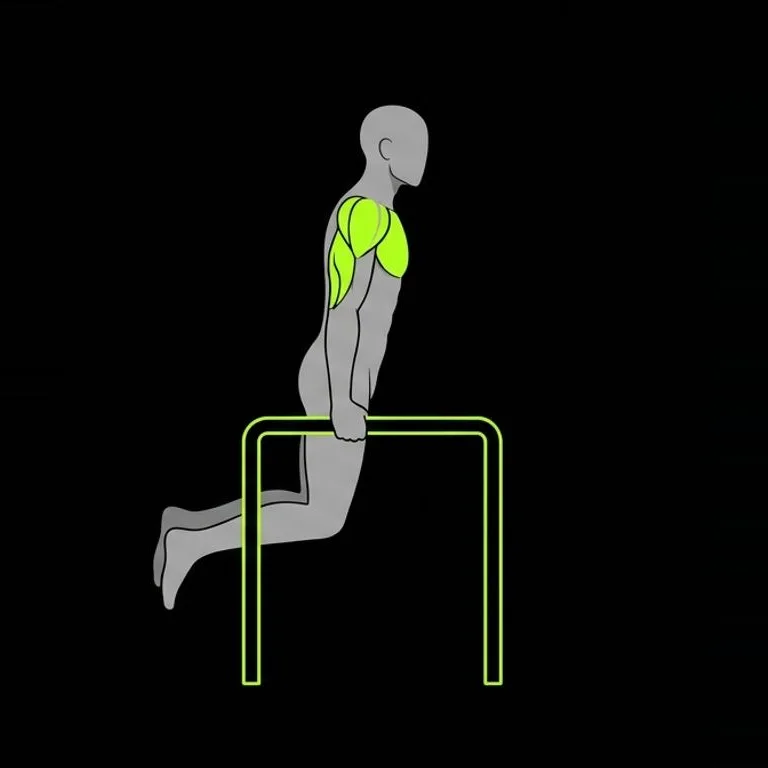
3 Press up and squeeze
Dip at a glance
| Dip | |
|---|---|
| Primary muscles | lower chest (pectoralis major), triceps |
| Also works | front of the shoulders |
| Equipment | Bodyweight |
| Rep range | 6–15 reps |
| Rest between sets | 90 seconds |
| Load step | Bodyweight |
A dip is a bodyweight press done on parallel bars: you hold yourself up on straight arms, sink down by bending your elbows, and push yourself back up. With a slight forward lean, it hits the lower part of the chest hard, along with the triceps and the front of the shoulders.
It is one of the few pressing movements where you move your whole bodyweight through a long range, which makes it demanding even without extra load. Lifters keep it in their plans because it builds pressing strength that carries over to the bench, and because a belt with a plate turns it into a heavy, progressive lift once bodyweight reps get easy.
How to set up
- Find a set of parallel bars or a dip station with handles roughly shoulder width apart. Bars that are much wider than your shoulders push the joint into an awkward position at the bottom.
- Grip the bars with your palms facing in, step or jump up, and lock your arms straight so you are supported above the handles.
- Press your shoulders down, away from your ears, so your neck looks long. Hanging with your shoulders shrugged up leaves them loose before you even start.
- Bend your knees and cross your ankles behind you, or let your legs hang slightly in front, whichever keeps you from swinging.
- Tip your chest forward a little so your torso is angled rather than bolt upright. That small lean is what turns a triceps dip into a chest dip.
How to do the dip
- Bend your elbows and lower yourself slowly, letting the elbows travel back and slightly out as your chest moves forward over your hands.
- Stop when your upper arms are about level with the bars, or slightly below if your shoulders feel settled there. Sinking far below that adds stretch on the front of the shoulder without adding much for the chest.
- Press through the heels of your hands to straighten your arms, keeping the same forward lean on the way up rather than snapping upright.
- Finish each rep with straight elbows and your shoulders pushed down, then begin the next descent from that stable top position.
- Keep your legs quiet. If you start kicking or swinging to get up, the set has ended; finish with a slow lowering or step down.
Cues that help
- Shoulders down, neck long. Keeping the shoulders depressed away from the ears holds the joint in a strong position through the whole range.
- Chest over the hands. Leaning forward shifts the load onto the chest; staying upright makes it mostly a triceps exercise.
- Lower like an elevator, not a trapdoor. A controlled descent keeps tension on the chest and stops you dropping into a bouncy, unstable bottom.
- Lock out every rep. Finishing with straight arms resets your shoulders and makes each rep count the same.
Common mistakes
- Dropping far too deep. Stop when your upper arms are roughly level with the bars. Depth beyond that mostly stresses the front of the shoulder.
- Shrugging the shoulders up toward the ears. Push down into the bars before each rep. If you cannot hold that position, use an assisted machine or a band until you can.
- Swinging the legs to get through reps. Cross your ankles and keep your legs still. Kipping takes the work away from the chest and makes the bottom position less controlled.
- Elbows flaring wide to the sides. Let them travel back and only slightly out. Bars set near shoulder width make this much easier.
Who it suits
Dips suit lifters who can already do a solid set of push-ups and want a harder bodyweight press, and anyone with access to parallel bars who wants to build the lower chest and triceps together.
They are a poor fit early on if you cannot yet support your bodyweight on straight arms, and for anyone whose shoulders do not like the bottom of the movement. If dips cause discomfort in the shoulder, stop and take a swap below rather than shortening the reps and hoping.
How Month6 progresses it
Month6 starts the dip at the bottom of its range, 6 reps, and adds reps session by session until every set reaches 15.
The dip has no plate to add, so progress on it is more reps at the same body weight, then a harder variation from the swaps below.
Rest on the dip is 90 seconds: long enough to repeat the effort, short enough to keep the session moving.
If bodyweight dips are out of reach, start with an assisted dip machine or a band looped under your knees, and reduce the help as you get stronger. A slow lowering from the top, stepping back up each time, builds the strength too.
Once you reach the top of the range with clean, controlled reps, add load with a dip belt or a dumbbell held between your feet. Month6 logs each set, so your progress stays visible after bodyweight stops being the challenge.
Swaps
- Push-up Take the push-up when you have no bars, or when you are still building the strength to hold your bodyweight on straight arms.
- Bench dip Take the bench dip when only a bench is available. It shifts the work onto the triceps, so keep the range comfortable and stop if the front of your shoulder complains.
- Machine chest press Take the machine chest press when the dip position does not sit well with your shoulders but you still want to load the chest hard.
Questions
Related exercises
More chest exercises: Chest · the whole library
Technique guidance for healthy adults, not medical advice; stop if a movement hurts. How every number is made, with its citations: Sources & method.
Log it, and let the plan move with you
Month6 logs every set of the dip in one tap, offers the swap when the station is taken, and adds load when you reach the top of the range.