How do you do a dumbbell curl with good form?
Rep range, rest and load step from the Month6 exercise catalog; last updated .
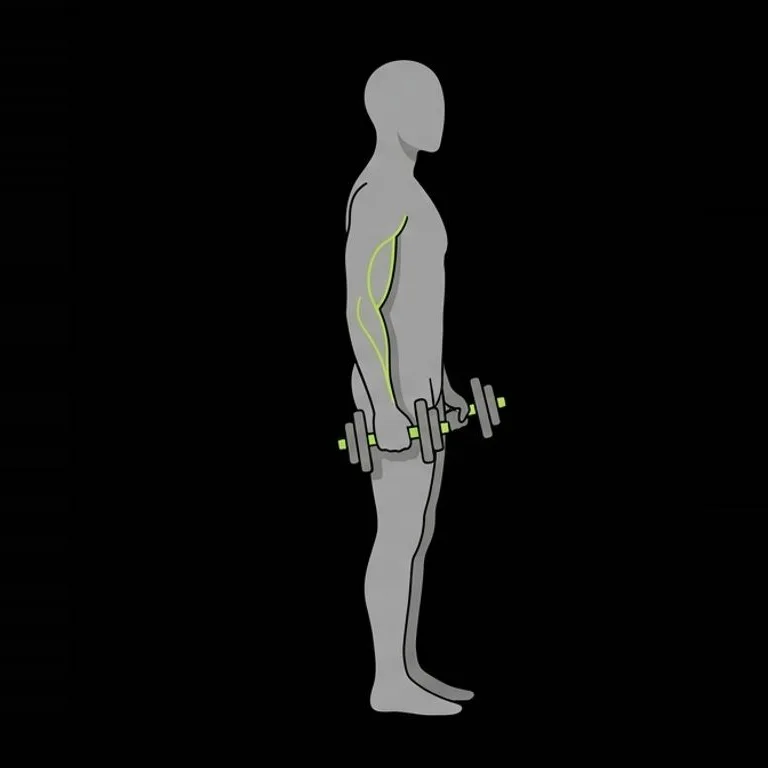
1 Set elbows and brace
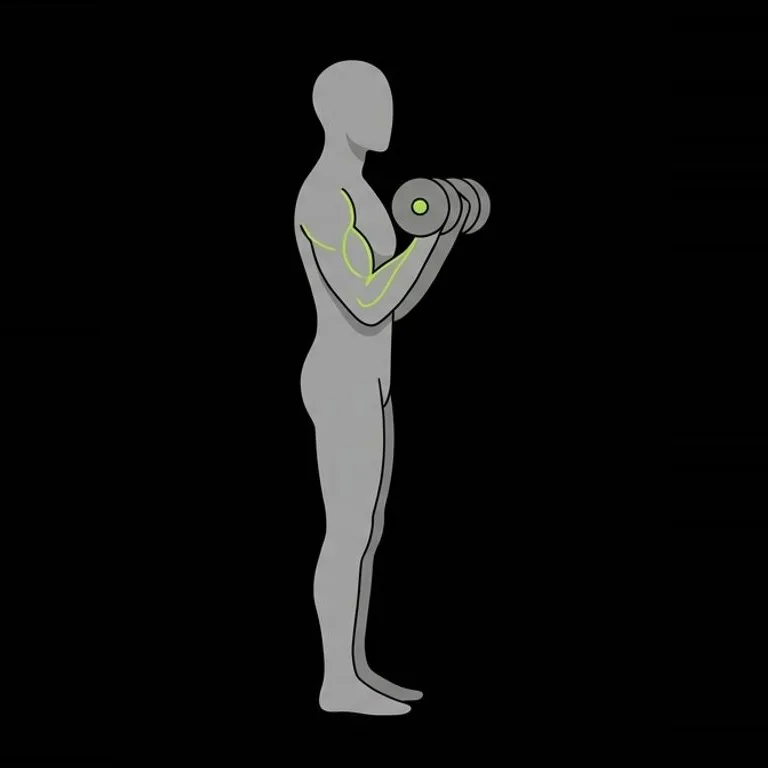
2 Move through the full range
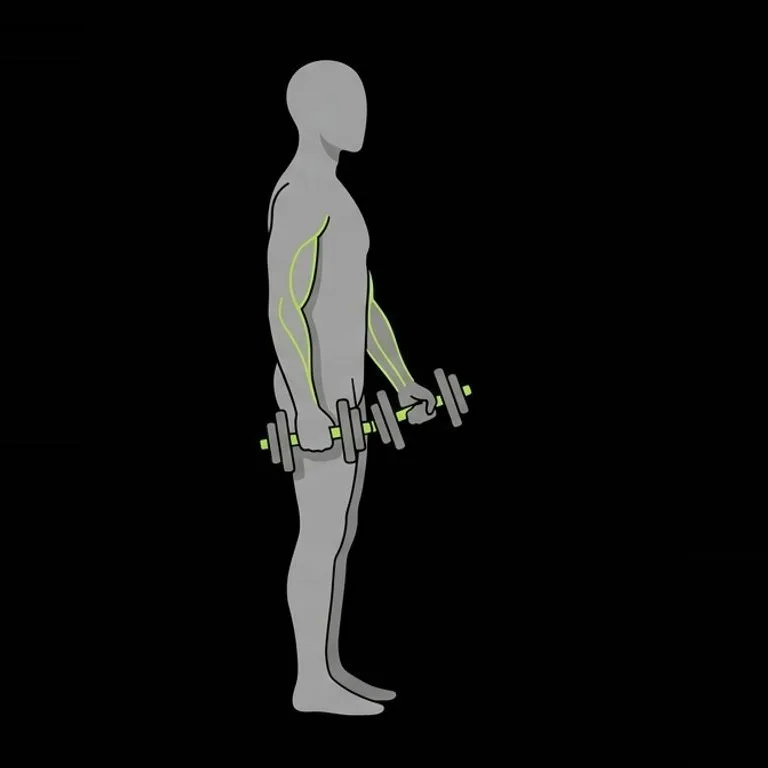
3 Squeeze, then lower slowly
Dumbbell curl at a glance
| Dumbbell curl | |
|---|---|
| Primary muscles | biceps (biceps brachii) |
| Also works | brachialis (under the biceps), forearm flexors, brachioradialis |
| Equipment | Dumbbells |
| Rep range | 10–15 reps |
| Rest between sets | 60 seconds |
| Load step | 1 kg (2.5 lb) |
The dumbbell curl is the classic arm exercise: hold a dumbbell in each hand, bend your elbows to bring the weights toward your shoulders, and lower them again. It is a single-joint movement, which means only the elbow moves. That makes it a direct way to load the biceps without the back or chest sharing the effort, as they do in a row or a chin-up.
Dumbbells add something a barbell cannot. Each arm works on its own, so a stronger side cannot cover for a weaker one, and your wrists are free to turn. Starting with the palms facing in and rotating them up as you lift uses the biceps' second job, turning the forearm, as well as bending the elbow. People train it for bigger, stronger arms, and because a few sets at the end of a pull day add up to a lot of arm work over a training block.
How to set up
- Pick a pair of dumbbells you can curl for the whole set without leaning back. Arms are small muscles, and the right weight for a clean curl is usually lighter than people grab first.
- Stand upright with your feet about hip width apart and your knees soft. Squeeze your glutes and brace your midsection a little so your torso does not sway.
- Let the dumbbells hang at arm's length by your sides. You can start with palms facing forward, or with palms facing your thighs and turn them up as you lift; both are fine as long as you choose one and stay with it.
- Pull your shoulders back and down and tuck your elbows against your ribs. Your upper arms are the hinge's fixed post, and they should stay there for the whole set.
- Grip the handles firmly but not with a white-knuckle squeeze. A death grip pulls the forearms into the lift more than it needs to.
How to do the dumbbell curl
- Bend at the elbow and curl the dumbbells up in a smooth arc. Only your forearms move; your upper arms stay against your sides and your shoulders stay still.
- If you started with palms facing in, rotate them up so the palms face the ceiling by the time the dumbbells pass your waist. The rotation should be done before the top, not added as a flick at the end.
- Stop when your forearms are close to vertical and the dumbbells sit in front of your shoulders. Squeeze the biceps for a beat at the top without letting the elbows drift forward to get the weight higher.
- Lower the dumbbells on a slow count until your arms are fully straight. The full stretch at the bottom is part of the rep; stopping halfway down leaves the hardest and most useful part out.
- You can lift both arms together or alternate one arm at a time. Alternating gives each arm a moment of rest and lets you focus on one side, but count each arm's reps the same way every session.
Cues that help
- Elbows glued to your ribs. A fixed upper arm keeps the biceps doing the lifting. When the elbows drift forward, the front of the shoulder helps and the curl gets easier without the arms working harder.
- Pinkies up at the top. Turning the little finger slightly toward the ceiling finishes the forearm rotation, which is one of the biceps' jobs and gives a stronger contraction.
- Straight arms at the bottom, every rep. The biceps work hardest in the stretched position. Cutting the bottom off shortens the rep and the work along with it.
- Chest up, hips still. If your torso leans back to start a rep, your hips are lifting the weight and the arms are just along for the ride.
- Lower slower than you lift. A slow lowering keeps the muscle under load for longer and stops you from using the bounce at the bottom to start the next rep.
Common mistakes
- Swinging the dumbbells up with the hips and lower back. Pick a lighter pair and stand with your back near a wall if it helps. Every rep should start from still arms.
- Elbows sliding forward at the top. Stop the curl when your forearms reach vertical. Lifting the dumbbells higher by raising the elbows only moves the work to the shoulders.
- Half reps that never straighten the arm. Lower until your elbows are fully extended before you start the next rep. If you cannot, the weight is too heavy for the full range.
- Wrists curling in or bending back. Keep the wrists neutral and in line with the forearm. Let the elbow do the bending; the wrist only holds the handle.
- Rushing through the lowering. Count slowly as the weights go down. Letting them drop wastes half the rep and puts a jolt on the elbow at the bottom.
Who it suits
The dumbbell curl suits anyone who wants more arm size or strength and has access to a pair of dumbbells. Beginners pick it up in a session, and it scales for experienced lifters by slowing the tempo or moving to the next dumbbell.
If the curl bothers your elbows or wrists, stop and choose a swap. A neutral-grip hammer curl is easier on the wrist for many people, a cable keeps the load steady through the rep, and a chin-up trains the biceps with your body weight as part of a pull.
How Month6 progresses it
Month6 starts the dumbbell curl at the bottom of its range, 10 reps, and adds reps session by session until every set reaches 15.
When every set of the dumbbell curl reaches the top of the range, the load goes up by the smallest sensible step for it — 1 kg (2.5 lb) — and the reps start again from 10.
Rest on the dumbbell curl is 60 seconds: an isolation or bodyweight movement recovers quickly.
Curls progress slowly in weight. The step between dumbbells is a big percentage of what the biceps can handle, so expect to sit at a weight for several sessions while you add reps. That is normal for a small muscle, not a stall.
Clean reps are the measure. A heavier dumbbell swung up with your back does less for your arms than a lighter one lifted strictly through the full range. Move up only when the top of the range feels controlled on every set.
Swaps
- Hammer curl Take the hammer curl when a palms-up grip strains your wrists, or when you want more work for the brachialis and forearms. The neutral grip often lets you handle a little more weight.
- Cable curl Take the cable curl when you want even tension from the bottom to the top of the rep. The cable keeps pulling at the bottom, where a dumbbell goes slack.
- Barbell curl Take the barbell curl when you want to load both arms heavier at once with smaller weight jumps. Use it if your wrists are comfortable in a fixed, palms-up grip.
- Chin-up Take the chin-up when there are no dumbbells free or you want a bigger movement that trains the biceps alongside the back. It is a pull, not a curl, so it also counts toward your back work.
Questions
Related exercises
More arms exercises: Arms · the whole library
Technique guidance for healthy adults, not medical advice; stop if a movement hurts. How every number is made, with its citations: Sources & method.
Log it, and let the plan move with you
Month6 logs every set of the dumbbell curl in one tap, offers the swap when the station is taken, and adds load when you reach the top of the range.