How do you do a standing overhead press with good form?
Rep range, rest and load step from the Month6 exercise catalog; last updated .
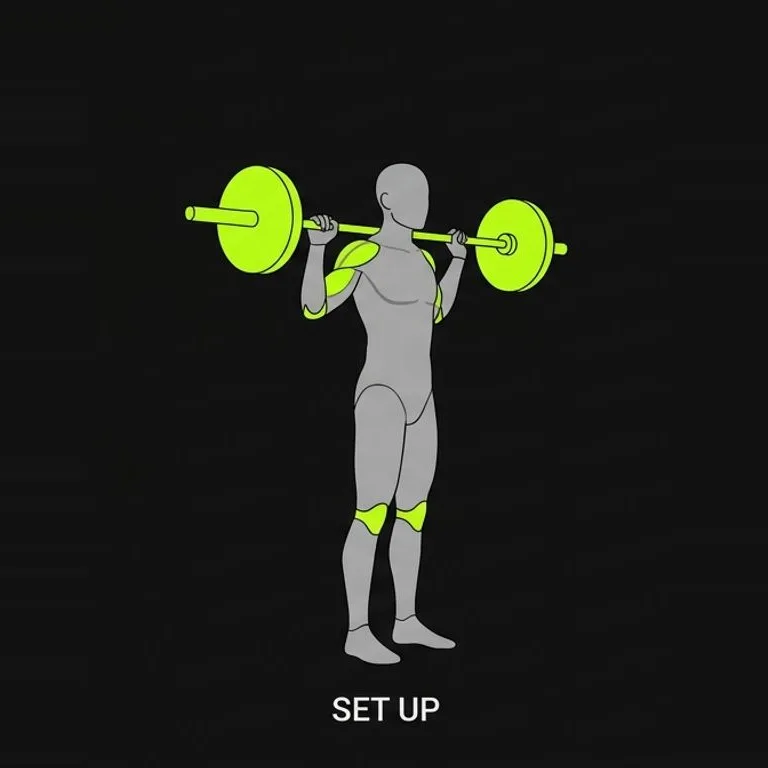
1 Set up tall and braced
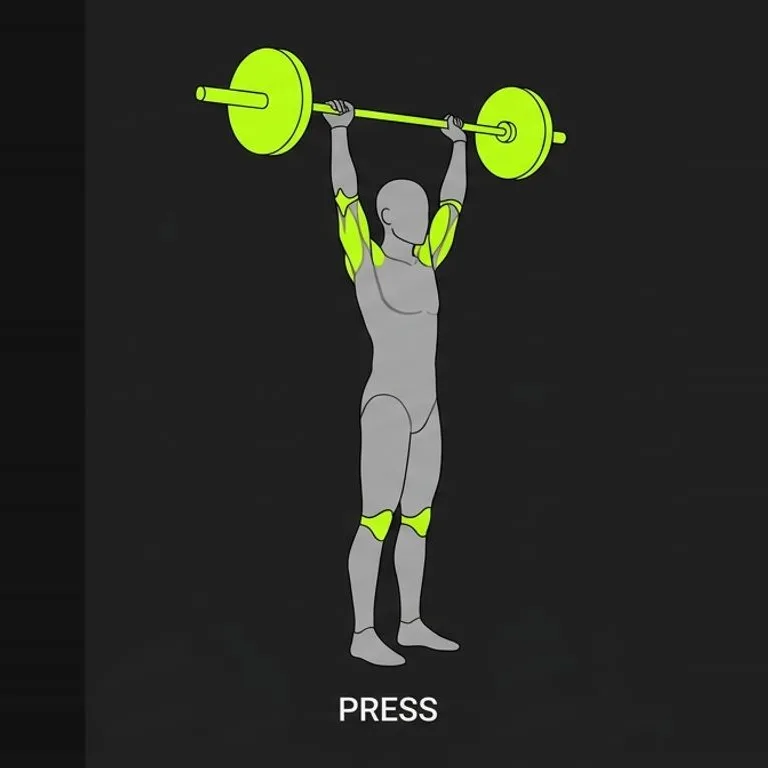
2 Press overhead in a straight path
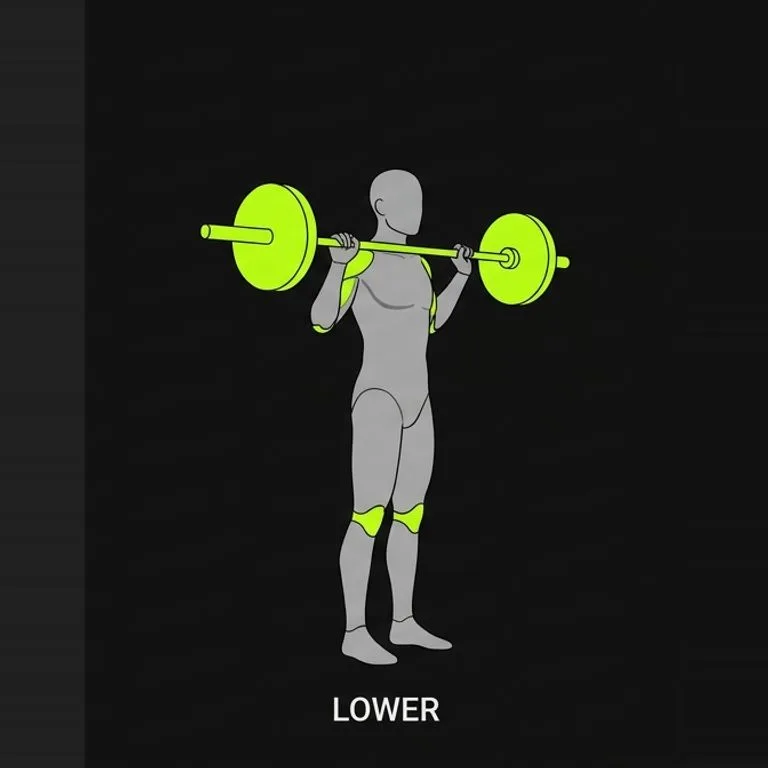
3 Lower under control to the start
Overhead press at a glance
| Overhead press | |
|---|---|
| Primary muscles | shoulders (front and side deltoids) |
| Also works | triceps, upper back, abdominals and glutes for bracing |
| Equipment | Gym (barbell, cable or machine) |
| Rep range | 6–10 reps |
| Rest between sets | 2.5 minutes |
| Load step | 2.5 kg (5 lb) |
The overhead press, sometimes called the military press or strict press, is a barbell lift where you stand tall and push the bar from your shoulders to straight arms above your head. Nothing supports your back, so your whole body has to stay rigid while the shoulders and triceps do the pressing.
It is the main barbell lift for the shoulders, and it builds strength you use any time you put something on a high shelf. Because you stand, it also trains your trunk and hips to hold steady under load. Progress is slower than on most lifts, which makes each small jump on the bar feel earned.
How to set up
- Set the bar in a rack at about the height of your upper chest, so you can unrack it with a slight bend of the knees rather than a calf raise.
- Take a grip just outside your shoulders, with the bar sitting low in your palms and your forearms vertical when viewed from the front.
- Step under the bar so it rests on the front of your shoulders, close to your collarbones, with your elbows slightly in front of the bar.
- Stand up to unrack it, take a couple of short steps back, and set your feet about hip width apart with your weight balanced over the middle of each foot.
- Squeeze your glutes, brace your stomach as if expecting a light punch, and take a big breath. That tension from your feet to your ribs is what you press from.
How to do the overhead press
- Pull your chin back a little and press the bar straight up, close to your face. Your head moves out of the way; the bar does not swing forward around it.
- As soon as the bar passes your forehead, push your head and chest forward under it, so you end up looking through the window made by your arms.
- Lock out with straight elbows and the bar directly over your shoulders, hips and the middle of your feet. From the side, the bar, your ears and your ankles form roughly one vertical line.
- Shrug up slightly at the top to finish the rep, then lower the bar under control back to your shoulders, pulling your head back again to let it pass.
- Rebrace before each rep. A breath held from the shoulders up through the press, then let out at the top or in the rack position, keeps the trunk solid.
Cues that help
- Glutes tight, ribs down. Locking the hips and keeping the ribcage from flaring stops your lower back arching as the bar goes up.
- Bar close to the face. A straight, vertical bar path is the shortest and strongest one; a bar that drifts forward pulls you off balance.
- Head through at the top. Moving your head forward under the bar stacks the load over your shoulders and spine instead of out in front of them.
- Elbows slightly in front of the bar. Starting with the elbows a touch forward puts the forearms under the bar so the press begins with a straight push.
- Grip the floor with your feet. Rooting your feet and driving them down as the bar rises keeps the whole body tense and the lift steady.
Common mistakes
- Leaning back into a standing incline press. Squeeze your glutes harder and lighten the bar. A big backward lean turns it into a different lift and strains the lower back.
- Pressing the bar forward around the face. Tuck your chin and keep the bar close as it rises. Your head moves, not the bar.
- Finishing with the bar in front of the head. Push your head through at the top until the bar sits over your shoulders and the middle of your feet.
- Using the legs to push the bar up. Keep your knees straight throughout. A dip and drive turns it into a push press, which is a separate lift.
Who it suits
The standing overhead press suits lifters who have a barbell and a rack and want a heavy, progressive lift for the shoulders. It sits well alongside a bench press in a plan, since the two press in different directions.
It is not the right choice if you cannot raise your arms fully overhead without arching your back hard, or if pressing overhead causes discomfort in the shoulder. In that case, stop and pick a swap: a seated dumbbell press with back support or a machine press reduces what the trunk has to do.
How Month6 progresses it
Month6 starts the overhead press at the bottom of its range, 6 reps, and adds reps session by session until every set reaches 10.
When every set of the overhead press reaches the top of the range, the load goes up by the smallest sensible step for it — 2.5 kg (5 lb) — and the reps start again from 6.
Rest on the overhead press is 2.5 minutes: a heavy compound lift recovers better with longer breaks.
The overhead press moves less weight than any other main barbell lift, and it climbs the slowest. Small plates are your friend here; a jump that feels tiny on a squat can be a large step for the shoulders.
When your reps stall, look at your setup before your effort: grip width, bracing and the head moving through. Month6 adds the smallest load step once you reach the top of the range, so clean reps at a given weight are the goal.
Swaps
- Dumbbell shoulder press Take the dumbbell shoulder press when you want each arm to find its own path, or when the barbell rack is taken. Doing it seated also takes balance out of the lift.
- Arnold press Take the Arnold press when you want a lighter shoulder press that turns the palms through the rep and spends more time working the front of the shoulder.
- Machine shoulder press Take the machine shoulder press when bracing is the limiting factor, such as late in a session or while you are still learning to hold your trunk tight.
- Pike push-up Take the pike push-up when you have no equipment. Raising your feet on a bench makes it closer to a true overhead press.
Questions
Related exercises
Technique guidance for healthy adults, not medical advice; stop if a movement hurts. How every number is made, with its citations: Sources & method.
Log it, and let the plan move with you
Month6 logs every set of the overhead press in one tap, offers the swap when the station is taken, and adds load when you reach the top of the range.