How do you do a dumbbell shoulder press correctly?
Rep range, rest and load step from the Month6 exercise catalog; last updated .
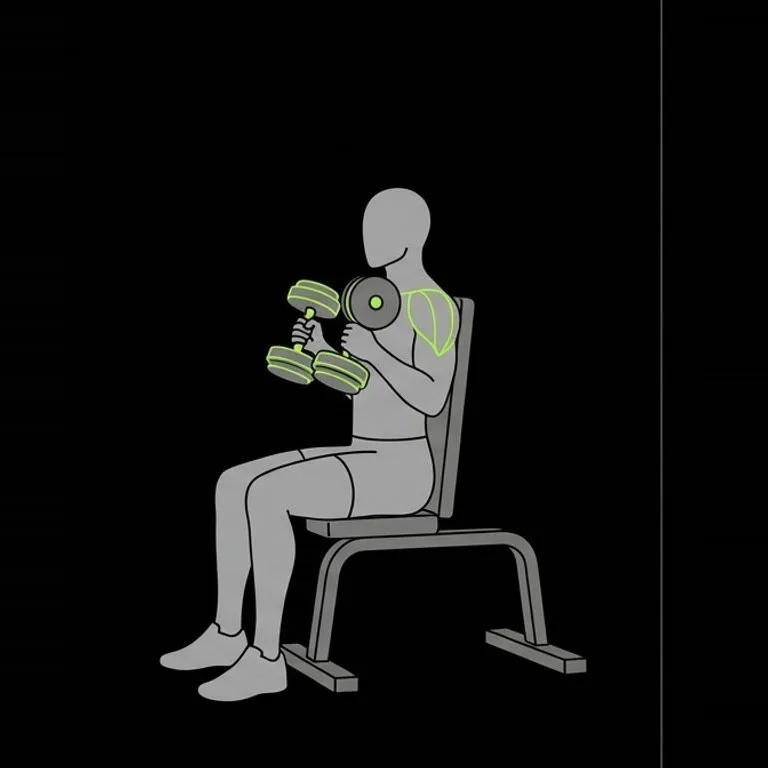
1 Set up tall and braced
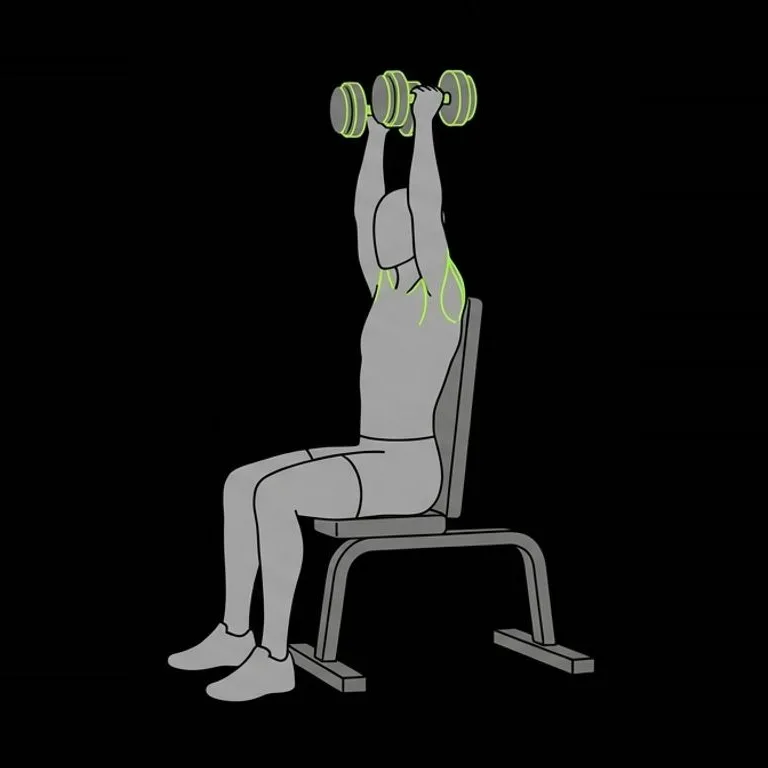
2 Press overhead in a straight path
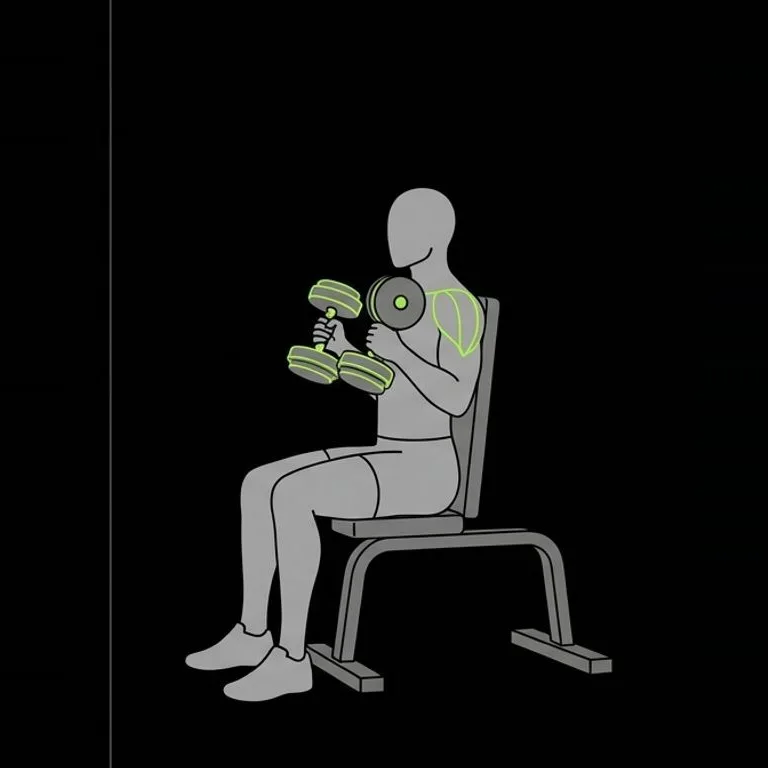
3 Lower under control to the start
Dumbbell shoulder press at a glance
| Dumbbell shoulder press | |
|---|---|
| Primary muscles | shoulders (front and side deltoids) |
| Also works | triceps, upper chest, upper back |
| Equipment | Dumbbells |
| Rep range | 8–12 reps |
| Rest between sets | 90 seconds |
| Load step | 2 kg (5 lb) |
The dumbbell shoulder press is an overhead press with a weight in each hand, most often done sitting on a bench with an upright back rest. You start with the dumbbells at shoulder height and push them up until your arms are locked out above your head.
It builds the same shoulder and triceps strength as the barbell overhead press, but each arm works on its own and the hands are free to find a comfortable path. Sitting with your back supported takes most of the balancing out of the lift, which lets you push the shoulders hard without your trunk giving out first. That makes it a dependable main shoulder movement and an easy one to add load to over time.
How to set up
- Set an adjustable bench to upright or one notch back from upright. A small recline keeps your back flat against the pad without turning the lift into an incline chest press.
- Sit with the dumbbells resting upright on your thighs, then lift one knee at a time to help pop each weight up to your shoulder. Once both are in place, settle your back against the pad.
- Hold the dumbbells just outside your shoulders at about ear height, palms facing forward or turned slightly in. Your forearms point straight up underneath the handles.
- Bring your elbows a little forward of your body instead of straight out to the sides. This places the shoulder in a more natural line for pressing.
- Plant your feet wide on the floor, keep your head against or just off the pad, and brace your stomach before the first rep.
How to do the dumbbell shoulder press
- Press both dumbbells up, letting them travel slightly inward so they finish above your head, close together but not touching.
- Straighten your elbows fully at the top without slamming them into lockout. Your biceps end up roughly beside your ears.
- Lower the weights slowly to about ear height or just above your shoulders. Going lower than that rarely helps and makes the next press harder to start cleanly.
- Keep your lower back on the pad for every rep. If you find yourself arching away from it to finish a press, the set is over or the dumbbells are too heavy.
- To finish, lower the dumbbells to your shoulders, then down to your thighs with control before setting them on the floor.
Cues that help
- Forearms vertical. A stacked forearm under each dumbbell sends the load straight through the arm and keeps the weights from drifting out wide.
- Elbows slightly forward. Angling the elbows a little in front of you lines up the press with how the shoulder joint naturally moves overhead.
- Press up and in. A gentle inward arc brings the weights over the middle of your head, where they are easiest to hold at lockout.
- Back stays on the pad. Leaving your back against the bench keeps the shoulders doing the work instead of letting a lean back turn it into a chest press.
Common mistakes
- Arching away from the back rest. Pick lighter dumbbells and keep your ribs down. An arch shifts the load to the upper chest and puts the lower back in a poor position.
- Elbows flared directly out to the sides. Bring them slightly forward so they sit in front of the torso. The press will feel smoother at the shoulder.
- Stopping well short of lockout. Finish every rep with straight arms overhead. Half presses leave the top of the range untrained.
- Dumbbells drifting forward in front of the face. Keep them over your shoulders on the way down and over your head on the way up. Forward drift makes them feel heavier than they are.
Who it suits
The dumbbell shoulder press suits beginners and experienced lifters alike. It is often easier to learn than the barbell press because the back rest takes care of posture, and it lets a lifter with a stronger and weaker side even them out.
It is less suitable once the heavy dumbbells become hard to get up to your shoulders, or if overhead pressing causes discomfort in the shoulder. If that happens, stop the set and choose a swap; a machine press guides the path and is simple to set up.
How Month6 progresses it
Month6 starts the dumbbell shoulder press at the bottom of its range, 8 reps, and adds reps session by session until every set reaches 12.
When every set of the dumbbell shoulder press reaches the top of the range, the load goes up by the smallest sensible step for it — 2 kg (5 lb) — and the reps start again from 8.
Rest on the dumbbell shoulder press is 90 seconds: long enough to repeat the effort, short enough to keep the session moving.
Shoulder strength climbs gradually, and the jump between dumbbell pairs can be large for this muscle. Stay at a weight until each set reaches the top of the range with full lockout and your back on the pad.
Month6 moves you to the next load step when you get there and drops the reps back to the bottom of the range. If a heavier pair is too much at first, keep working the lighter pair and slow the lowering until the jump feels manageable.
Swaps
- Overhead press Take the standing barbell press when you have a rack and want a heavier shoulder lift that also trains your trunk to stay rigid.
- Arnold press Take the Arnold press when you want to keep using dumbbells but with lighter weights and a rotation that spends more time on the front of the shoulder.
- Machine shoulder press Take the machine shoulder press when getting dumbbells into position is the hard part, or when you want a fixed path to push close to failure safely.
- Pike push-up Take the pike push-up when you are training with no equipment. Keep your hips high so the push is as close to overhead as you can make it.
Questions
Related exercises
Technique guidance for healthy adults, not medical advice; stop if a movement hurts. How every number is made, with its citations: Sources & method.
Log it, and let the plan move with you
Month6 logs every set of the dumbbell shoulder press in one tap, offers the swap when the station is taken, and adds load when you reach the top of the range.