How do you do a lat pulldown with good form?
Rep range, rest and load step from the Month6 exercise catalog; last updated .
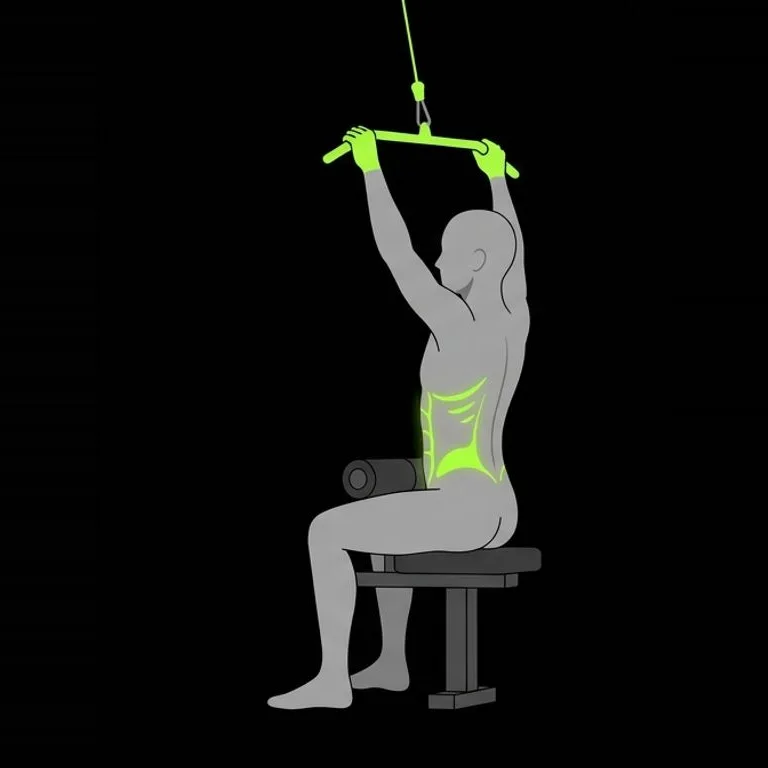
1 Set the grip, brace the core
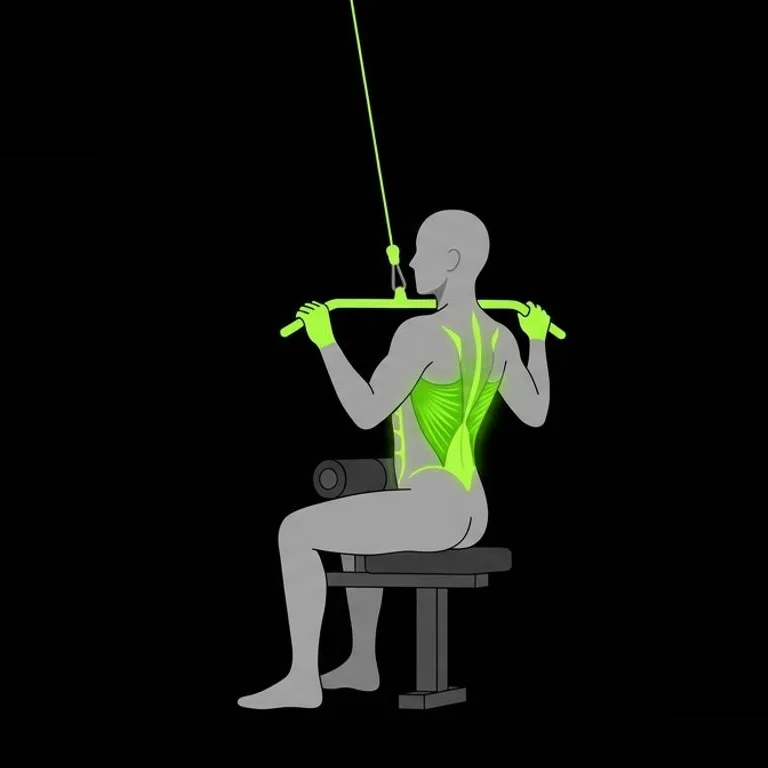
2 Pull with the elbows to full contraction
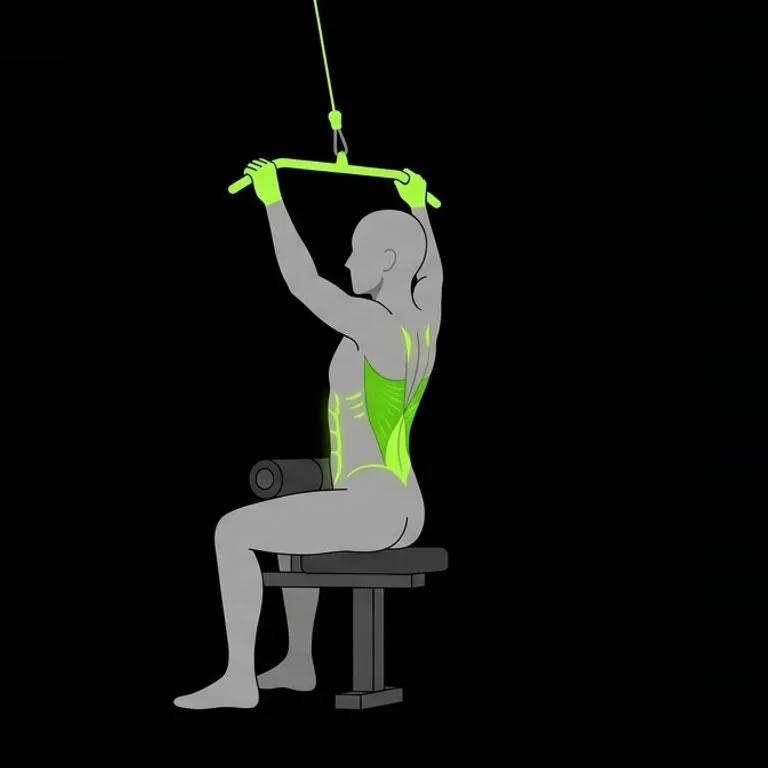
3 Control the stretch back
Lat pulldown at a glance
| Lat pulldown | |
|---|---|
| Primary muscles | lats |
| Also works | lower and middle traps, rhomboids, biceps, rear shoulders |
| Equipment | Gym (barbell, cable or machine) |
| Rep range | 8–12 reps |
| Rest between sets | 90 seconds |
| Load step | 2.5 kg (5 lb) |
The lat pulldown is a seated machine pull. You sit facing a cable stack, hook your thighs under a set of pads, reach up to a long bar and pull it down in front of your face to your upper chest. It trains the same vertical pulling pattern as a pull-up, but instead of lifting your body you choose a weight on the stack, from very light to very heavy.
That adjustable load is what makes it so useful. A beginner who cannot yet lift their own body can still train the lats through a full range, and an experienced lifter can add extra back volume after their bodyweight pulls are done. The cable gives smooth tension all the way up and down, the seat keeps you stable, and the pin lets you change the weight in seconds, which makes it one of the easiest back exercises to progress in small, steady steps.
How to set up
- Adjust the thigh pads so your legs are pinned snugly when you sit with your feet flat on the floor. Loose pads let you rise off the seat as the weight gets heavy; pads crushed down on your legs make it hard to sit tall.
- Stand up, take the bar with an overhand grip a little wider than your shoulders, and sit down with it, letting your arms straighten above you. The weight should already be lifting off the stack as you sit.
- Lean back just slightly from the hips, enough that the bar can travel past your face to your chest. Your chest stays up and your lower back keeps its natural curve.
- Let the shoulders rise towards your ears at the top so you start from a full stretch. That is the one point in the rep where shrugging is welcome.
- Plant your feet, brace your stomach and take a breath before the first pull.
How to do the lat pulldown
- Start the pull by drawing your shoulders down and back, then keep going by driving your elbows down towards your hips. Your hands mostly follow; the elbows do the steering.
- Bring the bar to your upper chest, around your collarbones. Lift your chest up to meet it so the upper back finishes the movement.
- Hold the bottom for a short pause with your shoulder blades squeezed together and your elbows tucked by your sides.
- Let the bar rise slowly, straightening your arms fully and letting your shoulders lift at the very top so your lats get a long stretch before the next pull.
- Keep your torso angle the same on every rep. If you have to throw your body back to finish a rep, that is the end of a clean set.
Cues that help
- Elbows to your hips. Pulling the elbows down rather than the hands shifts the effort onto the lats and stops the biceps from taking over.
- Chest up to the bar. Lifting the chest as the bar comes down engages the muscles between the shoulder blades and gives each rep a clear finish.
- Shoulders down before the arms bend. Setting the shoulders first starts every rep with the back and keeps the neck relaxed.
- Thumbs over the bar, hands as hooks. A looser, hook-like grip reduces how much the forearms and biceps pull, which leaves more of the work to the back.
- Long stretch at the top. Letting the arms straighten fully trains the lats through their whole range, which is where much of the growth comes from.
Common mistakes
- Leaning far back and rowing the bar to the stomach. Keep a small lean and pull to your upper chest. A big lean turns the pulldown into a different lift and lets you move more weight than your lats can handle.
- Pulling the bar behind the neck. Bring it down in front of your face instead. Pulling behind the head forces the shoulders into an awkward position for no extra benefit.
- Letting the stack yank your arms up. Control the return all the way to straight arms. The weight should never slam back onto the stack between reps.
- Rising off the seat as the set gets hard. Lower the thigh pads until they hold you firmly, and lighten the stack if you still lift off.
- Cutting the range short at the top. Let the bar rise until your elbows are fully straight. Half reps near the bottom feel strong but leave the stretch out.
Who it suits
The lat pulldown suits nearly everyone who trains in a gym with a cable station. It is the go-to choice when pull-ups are not possible yet, and a solid way to add back volume for lifters who can already do them. It also works well late in a session, when you are too tired for a hard bodyweight pull but still want clean reps.
If there is no machine where you train, or the station is taken, use one of the swaps below. If pulling overhead bothers your shoulders, stop, and try a row instead: it trains much of the same back with the arms lower.
How Month6 progresses it
Month6 starts the lat pulldown at the bottom of its range, 8 reps, and adds reps session by session until every set reaches 12.
When every set of the lat pulldown reaches the top of the range, the load goes up by the smallest sensible step for it — 2.5 kg (5 lb) — and the reps start again from 8.
Rest on the lat pulldown is 90 seconds: long enough to repeat the effort, short enough to keep the session moving.
Progress on the pulldown is easy to see because the stack goes up in small, even plates. Add weight only when every rep reaches your chest with the same small lean. If you need more lean to finish, you have found the load that is just too heavy.
If you are using the pulldown to build towards pull-ups, keep your form strict and try a slower lowering on your last set. The strength you build pulling a heavy stack through a full range carries over to lifting your body.
Swaps
- Pull-up Graduate to the pull-up when your pulldown is close to your body weight and you want to lift yourself instead of a stack. It needs only a bar and asks more of your trunk to keep you still.
- One-arm dumbbell row Reach for the dumbbell row when the cable station is busy or missing. It is a horizontal pull rather than a vertical one, but it trains the lats and upper back hard with one hand braced on a bench.
- Inverted row Try the inverted row when you have a bar and a rack but no machine. Lying under the bar with your heels on the floor, you pull your chest up to it, and the angle of your body sets the difficulty.
Questions
Related exercises
More back exercises: Back · the whole library
Technique guidance for healthy adults, not medical advice; stop if a movement hurts. How every number is made, with its citations: Sources & method.
Log it, and let the plan move with you
Month6 logs every set of the lat pulldown in one tap, offers the swap when the station is taken, and adds load when you reach the top of the range.